


| |
| Home |
| New Products |
| Contact us |
Human Growth arrest-specific protein 6 (Gas6) ELISA,
Recombinant, Antibody
A reliable biomarker associated with obesity,atherosclerosis,thrombosis and cancer |
||
|
||
CONTEXT:
Growth arrest-specific 6 (Gas6) is a vitamin K-dependent protein secreted by immune cells, endothelial cells, vascular smooth muscle cells, and adipocytes. Preclinical studies indicate that Gas6 and its receptors of the TAM (Tyro-3, Axl, Mer) family may be involved in the pathogenesis of obesity and its complications, including systemic inflammation and insulin resistance. Until now, little has been known about the clinical significance of the Gas6/TAM system in childhood obesity. OBJECTIVES:This study aimed to determine whether circulating Gas6 and soluble Axl (sAxl) levels are associated with adiposity, inflammation, and insulin resistance status among Taiwanese adolescents. METHODS: Cross-sectional analyses using the data from the Taipei Children Heart Study-III were performed. A total of 832 adolescents (average age, 13.3 years) were included; they were divided into 3 groups: lean, overweight, and obese. Circulating Gas6 and sAxl levels, adiposity, inflammatory markers, and insulin resistance status were examined. RESULTS:Levels of circulating Gas6 and sAxl were significantly higher in overweight and obese adolescents than in the lean group (both P < .05). Circulating Gas6 levels were significantly positively correlated with body mass index Z-score (P = .045), waist circumference (P < .001), waist to hip circumference ratio (P < .001), body fat mass (P = .02), serum high-sensitivity C-reactive protein (P = .005), and tumor necrosis factor-α levels (P = .039) among overweight and obese adolescents. The correlations remained significant after adjusting for age, gender, Tanner stage, smoking status, and drinking status. In addition, every 1 ng/mL increase in circulating Gas6 concentration corresponded to a 15% to 19% increase in the risk of developing insulin resistance among overweight and obese adolescents. CONCLUSIONS: Circulating Gas6 levels are strongly associated with adiposity, inflammation, and insulin resistance status among overweight and obese adolescents. The potential role of the Gas6/TAM system in the initiation of childhood obesity and obesity-associated complications deserves further attention. Hsiao FC, et al, J Clin Endocrinol Metab. 2013 Feb;98(2):E267-74. Growth-arrest-specific 6 (GAS6) protein in ARDS patients: determination of plasma levels and influence of PEEP settingBACKGROUND: Growth-arrest-specific protein 6 (GAS6) is a vitamin K-dependent protein expressed by endothelial cells and leukocytes participating in cell survival, migration and proliferation and involved in many pathological situations. The aim of our study was to assess its implication in ARDS and its variation according to PEEP setting, considering that different cyclic stresses could alter GAS6 plasma levels.METHODS: Our subjects were enrolled in the ExPress study comparing a minimal alveolar distention (low-PEEP) ventilatory strategy to a maximal alveolar recruitment (high-PEEP) strategy in ARDS. Plasma GAS6, interleukin-8 (IL-8), and vascular endothelial growth factor (VEGF) levels were measured at day 0 and day 3 by enzyme-linked immunosorbent assay in blood samples prospectively collected during the study for a subset of 52 subjects included in 8 centers during year 2005. RESULTS: We found that GAS6 plasma level was elevated in the whole population at day 0: median 106 ng/mL IQR 77-139 ng/mL, with significant correlations with IL-8, the Simplified Acute Physiology Score II and the Organ Dysfunction and Infection scores. Statistically significant decreases in GAS6 and IL-8 plasma levels were observed between day 0 and day 3 in the high-PEEP group (P = .02); while there were no differences between day 0 and day 3 in the low-PEEP group. CONCLUSIONS: GAS6 plasma level is elevated in ARDS patients. The high-PEEP strategy is associated with a decrease in GAS6 and IL-8 plasmalevels at day 3, without significant differences in day 28 mortality between the 2 groups. (Clinicaltrials.gov NCT00188058). Diehl JL et al. Respir Care. 2013 Nov;58(11):1886-91 Umbilical cord plasma levels of growth-arrest specific protein 6 in intrauterine growth restriction. OBJECTIVE: Growth arrest specific protein 6 (GAS6) is a newly discovered |
||
Handberg A, et al. J Clin Endocrinol Metab. 2010 Apr;95(4):1939-46. Epub 2010 Feb 5. |
||
| Human soluble AXL ELISA Kit | ||
 |
||
 |
||
 |
||
 |
||
 |
||
 |
||
 |
||
 |
||
 |
Gas6 (Human) ELISA Kit Code No.: SK00098-01 Size: 96 T Price: $360.00 USD Standard range: 125-8000 pg/ml Sensitivity: 31 pg/ml Sample type: plasma, serum Sample Dilution: 5 Intra-CV: 4-6% Inter-CV: 8-10% Data Sheet: PDF |
|
 |
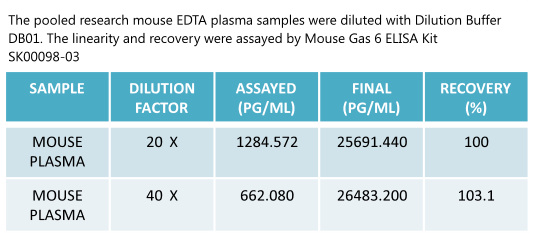
Gas6 (Mouse) ELISA Kit Code No.: SK00098-03 Size: 96 T Price: $360.00 USD Standard range: 39-2500 pg/ml Sensitivity: 10 pg/ml Sample type: plasma, serum Sample Dilution: 20 Intra-CV: 4-6% Inter-CV: 8-10% Data Sheet: PDF |
|
 |
Gas6 (Rat) ELISA Kit Code No.: SK00098-07 Size: 96 T Price: $420.00 USD Standard range: 39-2500 pg/ml Sensitivity: 10 pg/ml Sample type: plasma, serum Sample Dilution: 10-20 Intra-CV: 4-6% Inter-CV: 8-10% Data Sheet: PDF |
|
 |
Anti Gas6 (Human) IgG Code No.: A00098-01-100 Size: 100 ug Price: $260.00 USD Host: Rabbit Antigen: Human Gas6 Rec. Antibody Type: IgG Purification: Protein A affinity Applications: IHC (2-4 ug/ml); E (0.1ug/ml) Data Sheet: PDF |
|
|
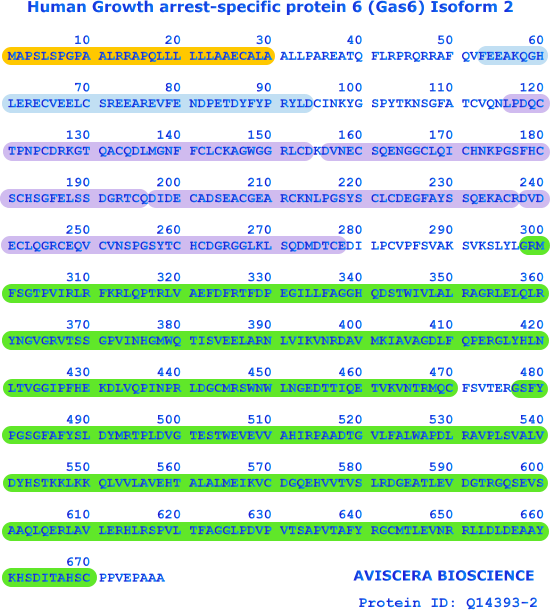
Gas6 (Human) Isoform 1Recombinant Code No.: 00098-01-100 Size: 100 ug Price: $360.00 USD sequence: A31-A678 Protein ID NP_000811 Gene ID: NM_000820 MW: 89.9 KD Tag: His tag on its N terminus Applications: ELISA, Antibody Production, Cell Biology Data Sheet: PDF |
||
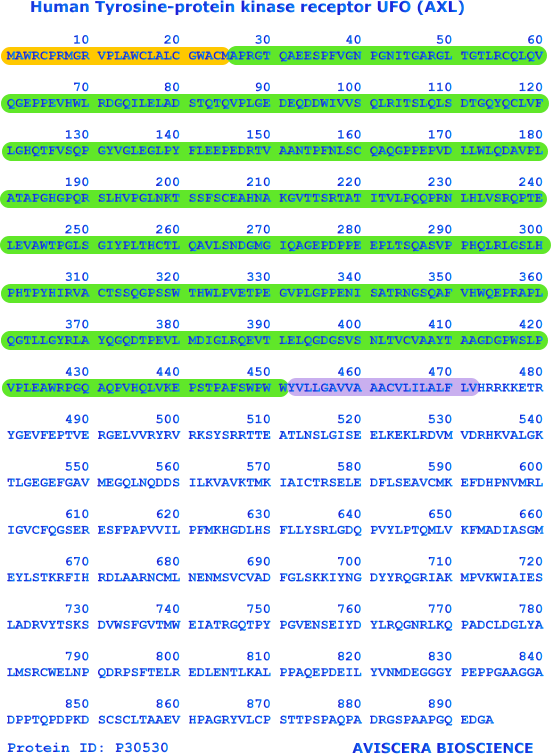
| Gas6 as a ligand for Receptor AXL | ||
|
||
| Name |
Code No. |
Size
|
Price |
| Gas6 (Human) ELISA Kit |
96 T
|
360.00
|
|
| Gas6 (Rat) ELISA Kit | SK00098-07 | 96 T | 420.00 |
| Gas6 (Mouse) ELISA Kit |
96 T
|
360.00
|
|
| Soluble AXL (Human) ELISA Kit |
96 T
|
360.00
|
|
| Gas6 (Human) Rec. | 00098-01-100 | 100 ug | 360.00 |
| Anti Gas6 (Human) IgG , host Rabbit | A00098-01-100 | 100 ug | 260.00 |
| Anti Gas6 (Human) IgG, Biotinylated | A00098-02-50 | 50 ug | 330.00 |
| Anti Gas6 (Human) Monoclonal Antibody | A00098-04-100 | 100 ug | 350.00 |
|